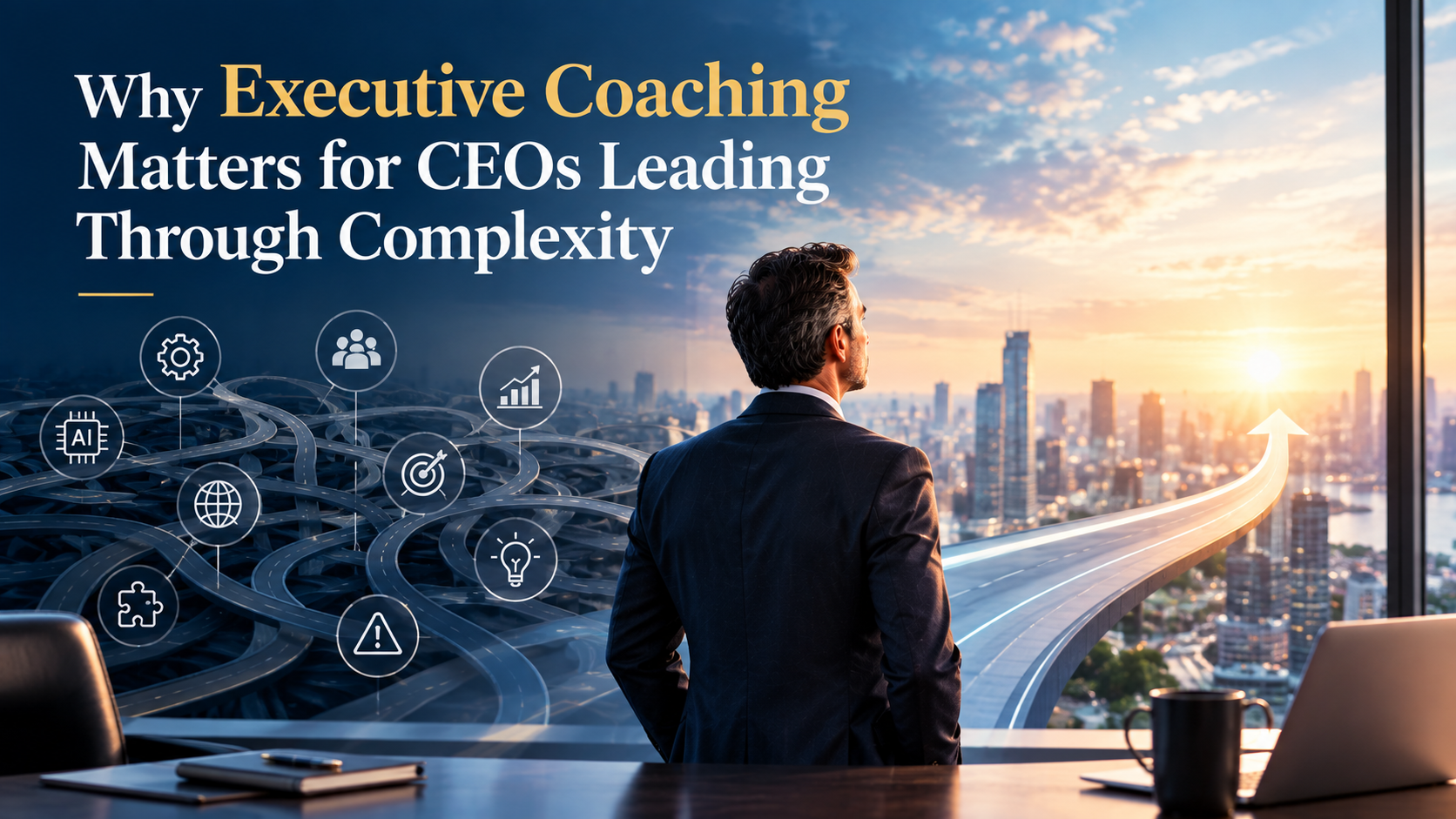
Being a CEO means making consequential decisions with incomplete information, competing priorities, and little room for error. As organizations face technological change, evolving workforce expectations, growth pressures, and complex strategic challenges, experience alone may not provide every answer. Executive coaching for CEOs gives leaders a structured environment to examine decisions, challenge assumptions, strengthen communication, and become more intentional about how they lead.
At Daymark Group, leadership development connects individual growth with organizational performance. Its work brings together leadership development, organizational psychology, business strategy, and practical insight into the challenges facing senior leaders.
Why CEOs Need More Than Experience
Experience can prepare leaders for familiar challenges, but organizations rarely remain static. A CEO who succeeded during a period of rapid growth may need to lead differently through restructuring, succession, market expansion, or technological transformation.
CEOs can also find it difficult to obtain candid feedback. Employees may be reluctant to challenge the person at the top, while board discussions tend to center on governance, performance, and strategic priorities. A trusted coaching relationship creates a separate environment for reflection and honest examination.
Effective executive coaching for CEOs can help uncover leadership patterns that may otherwise remain difficult to recognize. These can include communication habits, delegation challenges, decision-making tendencies, or differences between leadership intent and how others experience it.
What Effective CEO Coaching Should Address
Coaching should reflect the leader’s actual responsibilities and organizational environment rather than rely on a generic checklist.
Strengthening strategic decisions
CEOs frequently make decisions without complete information. Coaching can provide a disciplined process for examining assumptions, clarifying trade-offs, and separating immediate pressures from longer-term strategic priorities.
The objective is not for a coach to make decisions on the CEO’s behalf. It is to improve the quality of the thinking that informs those decisions.
Improving leadership communication
A CEO’s words can influence priorities, employee confidence, and organizational alignment. Coaching can help leaders become more deliberate when communicating strategy, addressing disagreement, delivering difficult messages, or guiding teams through uncertainty.
Leading transformation
Technology, including AI, is changing how organizations approach work, capabilities, and decision-making. Daymark Group’s AI work recognizes that successful transformation involves more than implementing technology. Leaders must also consider organizational readiness, roles, capabilities, governance, and the behaviors required for adoption.
Actionable step: Choose one major transformation initiative and identify the behavior that needs to change, the person accountable for that change, and the evidence that will demonstrate progress.
Connecting Individual Development to Organizational Performance
CEO coaching has greater value when it is connected to the organization around the leader. Leadership behavior influences executive-team effectiveness, culture, communication, strategic execution, and organizational alignment.
This is where executive leadership development programs can complement individualized coaching. Coaching focuses closely on a particular leader, while broader development initiatives can establish shared leadership capabilities and expectations across an organization.
For example, a CEO might work on communicating a new strategy while other senior leaders develop the capabilities needed to execute it. Daymark Group’s leadership offerings include leadership development programs and academies, high-performance team development, leadership competency modeling, and AI-enabled leadership strategy.
The goal should not be a series of disconnected workshops. Development should address capabilities that matter to the organization’s actual strategy and challenges.
Turning Coaching Into Action
Insight only becomes useful when it changes behavior. A practical coaching engagement should therefore connect reflection with specific actions.
Define the leadership challenge
Avoid vague goals such as “become a better leader.” Identify the issue that needs attention. It might involve executive-team alignment, delegation, succession, strategic communication, organizational change, or another defined challenge.
Use evidence and feedback
Self-awareness is important, but it should be supported by evidence where appropriate. Stakeholder feedback, assessments, performance information, and other relevant inputs can help establish a clearer picture of leadership strengths and development opportunities.
Test new approaches
A CEO can turn coaching insights into practical experiments. This might involve changing the structure of executive meetings, delegating a recurring category of decisions, or adopting a different approach to communicating organizational change.
The following coaching conversation can then examine the results and determine what should change next.
Measure meaningful outcomes
Leadership development does not always produce a single measurable result. However, organizations can track relevant indicators such as stakeholder feedback, team alignment, decision effectiveness, execution, retention, or progress toward strategic objectives.
Before beginning a coaching engagement, identify one leadership challenge and two observable outcomes that would indicate meaningful progress. This gives the work a practical starting point and a basis for evaluating its impact.
Why Customization Matters at the CEO Level
No two CEOs operate under identical circumstances. A founder preparing for organizational scale faces different challenges from an established CEO managing transformation or succession.
That is why executive coaching for CEOs should consider the leader’s responsibilities, organizational context, strategic priorities, culture, and immediate pressures.
Daymark Group supports this customized approach through a network of 54 vetted partners and coaches. That breadth allows leadership expertise to be matched more closely to the needs of an individual leader and organization rather than forcing every engagement into the same model.
This can be especially relevant when coaching intersects with organizational transformation, executive-team dynamics, succession, or other complex leadership issues.
Developing Leadership Beyond the CEO
Organizations become more resilient when leadership capability extends beyond one individual. Developing senior and emerging leaders can create greater consistency in how strategy is executed and how teams respond to change.
Executive leadership development programs can provide a broader foundation by establishing leadership expectations and developing capabilities across multiple levels. Coaching can then provide more individualized support where specific leaders face distinctive challenges.
Daymark Group’s work spans executive and C-suite coaching, emerging and mid-level leader coaching, high-performance team development, and leadership competency modeling. This broader perspective helps organizations consider leadership as an organizational capability rather than an individual trait.
Choosing the Right Coaching Partner
For a CEO, trust and confidentiality are fundamental. The right coaching relationship should also demonstrate strategic understanding and the ability to work within the leader’s organizational context.
When evaluating a provider, consider whether it can:
- Connect leadership development to business priorities
- Customize the engagement around defined objectives
- Address complex organizational challenges
- Incorporate meaningful feedback and evidence
- Translate insights into practical behavioral changes
- Maintain an appropriate level of confidentiality and professionalism
- Adapt as leadership priorities evolve
A provider’s expertise should ultimately be evaluated by how well it can help the leader address the challenge that matters most—not simply by the number of services it offers.
Make CEO Development a Strategic Priority
Leadership development creates meaningful value when it changes how leaders make decisions, communicate, develop teams, and translate strategy into action. Executive coaching for CEOs provides a structured opportunity to examine those areas and turn greater self-awareness into deliberate leadership behavior.
For organizations facing growth, transformation, succession, or increasing strategic complexity, the key question is not simply whether a CEO should receive coaching. It is which leadership capabilities will matter most for the organization’s next stage and how intentionally those capabilities are being developed.
Daymark Group approaches leadership development through the combined lens of leadership, organizational psychology, strategy, and business impact. Connect with Daymark Group to discuss the leadership challenge your organization is facing and determine what development approach can best support your next stage of growth.
FAQs
1. What is the value of executive coaching for CEOs?
Executive coaching for CEOs provides a confidential environment where leaders can examine strategic decisions, communication, behavioral patterns, and complex leadership challenges. The greatest value comes when coaching is connected to specific organizational priorities and observable outcomes.
2. How do executive leadership development programs differ from CEO coaching?
Executive leadership development programs typically develop capabilities across a broader group of leaders, while CEO coaching focuses on the individual leader’s responsibilities, challenges, behaviors, and strategic impact. Organizations can use both approaches to strengthen leadership at the individual and enterprise levels.
3. When should a CEO consider executive coaching?
Executive coaching for CEOs can be particularly useful during periods of organizational growth, transformation, succession, strategic change, or increased leadership responsibility. It can also help a CEO address a specific leadership challenge before it creates broader organizational consequences.
 January 24, 2026 · 1 min read
 January 24, 2026 · 1 min read
 January 24, 2026 · 1 min read